
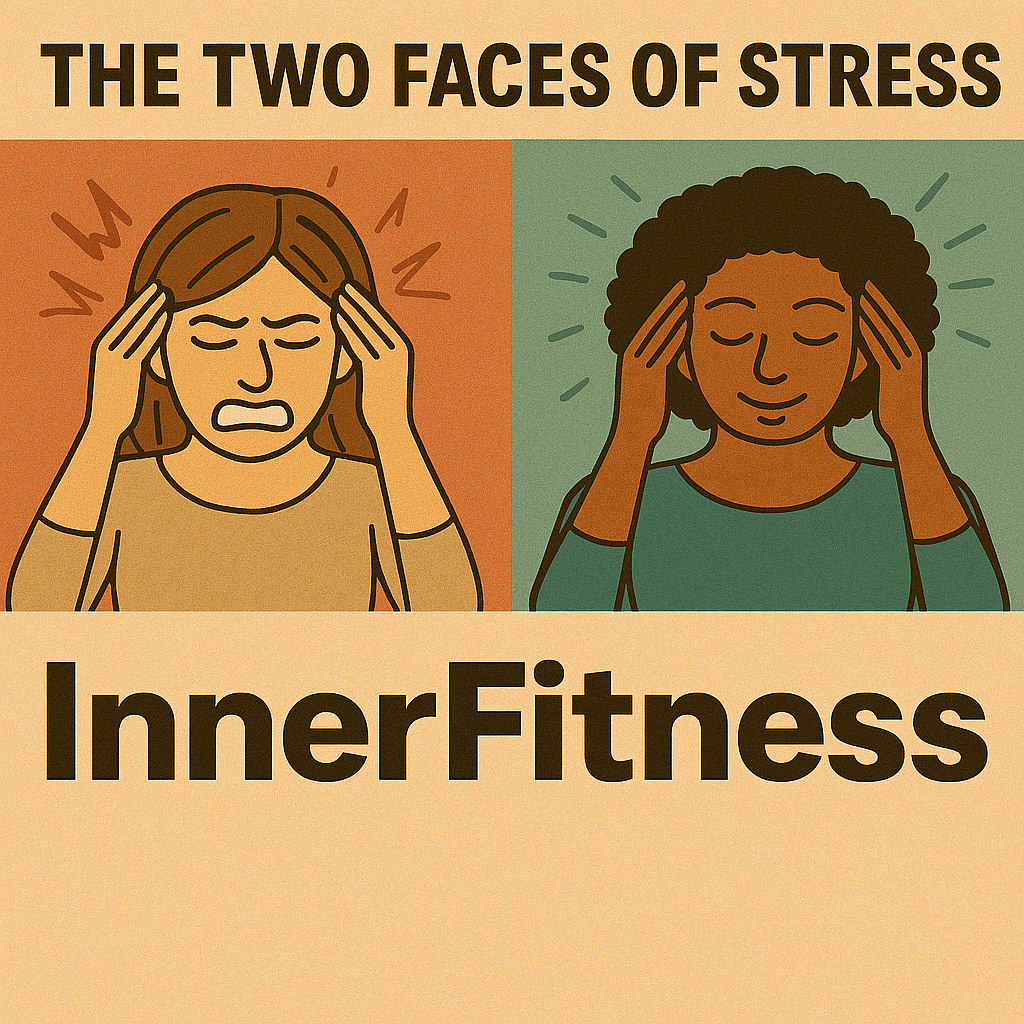
The Two Faces of Stress — And the New-Year Wisdom to Choose the Right One
- Emotional, Health, Life, Mental, Wellness
- By NordineZouareg
Balancing work, family, and self-care can feel overwhelming—yet with intention, the chaos can soften into harmony.
January has a certain magic—fresh calendars, fresh goals, fresh promises. But let’s be honest: the new year doesn’t erase your responsibilities. The same emails show up. The same family needs you. The same body asks for sleep. The same mind tries to sprint before it can breathe.
So the real question isn’t “How do I eliminate stress this year?”
It’s this:
How do I choose the kind of stress that strengthens me—and release the kind that slowly breaks me?
Because stress has two faces.
One is purposeful pressure—the kind that builds capacity, character, and confidence.
The other is endless strain—the kind that drains your nervous system, dulls your joy, and makes you feel like you’re surviving your own life.
Your well-being this year depends on knowing the difference—and having the courage to act on it.
The misunderstanding of stress
We talk about stress like it’s automatically bad. But stress is a biological response, not a moral failure. It’s your body mobilizing energy—adrenaline, cortisol—so you can meet a demand.
In the right dose, stress can sharpen focus and improve performance. In research on short-term “fight-or-flight” stress, scientists describe it as a response that can enhance protection and performance, including aspects of immune function. (PMC)
But when stress becomes constant—when the body never gets to come back down—what once helped you starts to harm you. Chronic stress is widely associated with negative health outcomes and physiological wear-and-tear over time. (PMC)
So here’s the truth:
Not all stress is equal. And your next level this year won’t come from “handling more.”
It’ll come from handling what matters—and letting the rest go.
Eustress vs. distress: the stress that builds you and the stress that depletes you
Think of stress in two categories:
1) Eustress — the stress of becoming
Eustress is meaningful challenge. It stretches you, but it doesn’t poison you. It has an endpoint. It has a purpose. It is followed by recovery.
Eustress sounds like:
- “This is hard, but it matters.”
- “I’m nervous, and I’m growing.”
- “I’m being tested, and I’m expanding.”
You feel eustress when:
- You’re preparing for something aligned with your values.
- You’re pushing your fitness, skill, or leadership capacity.
- You’re doing hard things with a recovery rhythm.
Eustress is the burn of the workout that rebuilds you.
The butterflies before the speech that sharpens you.
The discomfort of change that upgrades you.
2) Distress — the stress of endless survival
Distress is what happens when demands outweigh recovery and pressure has no meaning—only repetition.
Distress sounds like:
- “I can’t shut my mind off.”
- “I’m doing everything and feeling nothing.”
- “Even when I rest, I don’t recover.”
Chronic stress is linked to changes in brain and body over time, and Harvard Health notes that chronic stress can shrink the prefrontal cortex—an area involved in memory and learning. (Harvard Health)
That’s why distress is so dangerous: it makes you less capable while demanding more from you.
The new-year trap: “I’ll push hard now… and recover later”
A lot of high performers start the year like this:
- More goals
- More discipline
- More grind
- More pressure
- Less sleep
- Less space
- Less joy
They call it ambition.
But many times, it’s just distress wearing a motivational mask.
This year, I want you to start differently.
Not with a bigger to-do list.
With a clearer inner standard:
My stress must have meaning—or it must have boundaries.
A simple test: “Does this pressure build me—or drain me?”
Here’s the question I use with clients—especially in January, when people are deciding what they’ll tolerate for the next 12 months:
Does this stress build a skill, deepen a relationship, or move me toward a meaningful goal?
- If yes, it’s likely eustress. Lean in—but schedule recovery like it’s part of the goal.
- If no, it’s distress. Your work is not to “tough it out.” Your work is to change the pattern—through boundaries, systems, support, or a hard decision.
Protecting your peace isn’t weakness.
It’s wisdom.
The Stress-Resilience Formula for 2026
If you want intention, harmony, and well-being this year, you need a repeatable framework—not wishful thinking.
1) Identify the true source
Ask:
- Is this stress external (deadlines, conflict, finances)?
- Or internal (perfectionism, people-pleasing, fear, guilt)?
External stress requires strategy.
Internal stress requires honesty.
2) Assign meaning—or remove it
If the pressure is tied to something real—growth, contribution, love—your nervous system can interpret it as challenge instead of threat.
If it’s not tied to meaning, stop calling it “life.”
It’s just noise with consequences.
3) Build the rhythm: stress + rest = growth
The body doesn’t become resilient during pressure.
It becomes resilient during recovery.
Research distinguishes short-term stress that can be adaptive from long-term stress that can suppress or dysregulate immune responses. (PMC)
So if your schedule has pressure but no recovery, you are not training resilience—
you are training breakdown.
4) Practice active recovery (not passive escape)
Active recovery tells your system: You’re safe. You can repair.
Examples:
- Walking without a phone
- Breathwork (even 3 minutes)
- Journaling to discharge mental loops
- Time in nature
- Connection (real conversation, not scrolling)
Escape numbs.
Recovery restores.
5) Set boundaries that make harmony possible
Boundaries aren’t walls.
They are the architecture of well-being.
A boundary is simply this:
“This is what I allow—and this is what I no longer tolerate.”
If everything is flexible, your priorities become fiction.
The power of perception: your mindset changes your biology
One of the most important insights about stress is this:
How you interpret stress changes how it affects you.
A large U.S. sample study found that people who reported high stress and believed stress was harming their health had worse health outcomes—including higher risk of death—than those who reported high stress but did not view it as harmful. (PMC)
That doesn’t mean stress is “all in your head.”
It means your nervous system is always listening to your meaning.
When you label everything as danger, your body stays in defense mode.
When you label the right things as growth, your body mobilizes with more intelligence.
This year, make this your practice:
Reframe pressure into purpose—then back it up with recovery.
Your New-Year Stress Audit: 10 minutes that can change your year
Take a breath. Grab a pen. Don’t overthink it.
Step 1: List your top 5 stressors right now
Work. Money. Relationship. Health. Time. Family. Whatever it is.
Step 2: Label each one
For each stressor, write:
- EUSTRESS (builds me)
or - DISTRESS (drains me)
Step 3: Choose one action per category
For eustress, your action is: “How will I recover after I push?”
For distress, your action is: “What boundary or change do I need now?”
That’s intention.
That’s harmony.
That’s self-respect.
A new-year story I see all the time
A high-achiever comes to me with a “problem” that sounds like productivity:
“I need better focus.”
“I need more discipline.”
“I need a stronger mindset.”
But what they really need is stress discernment.
Because they’ve been treating distress like it’s proof of ambition.
They’ve been calling exhaustion “drive.”
They’ve been postponing life until “things slow down.”
And here’s the turning point:
They don’t lose their edge when they build recovery.
They gain sustainability.
They don’t become less successful when they set boundaries.
They become more alive while succeeding.
That’s the goal this year:
Not just to achieve more— but to feel more.
The January vow
Let this be your vow—not a resolution you abandon, but a standard you live:
- I will welcome the stress that strengthens me.
- I will release the stress that depletes me.
- I will treat recovery as part of progress.
- I will protect peace the way I protect goals.
Because growth requires pressure— but it does not require punishment.
Reflective question
What is one area of your life where you can replace toxic tension with meaningful challenge—and what boundary would make that possible?
Nordine Zouareg
InnerFitness® — Transforming Lives from the Inside Out™
Disclaimer: This article is meant to inspire reflection and support well-being. It is not a substitute for professional medical or mental health advice. If you’re experiencing severe anxiety, insomnia, depression, or overwhelming stress, please seek support from a qualified healthcare or mental health professional. Asking for help is strength.
- Private Coaching
- NZ90® Total Transformation System (money-back guarantee)
- Pre-order: The No-Limits Life™ (09/01/2026)
- Get updates on the InnerFitness® App
- No-Limits Life Podcast: Listen or Watch
Facebook
Twitter
LinkedIn
WhatsApp
Email