
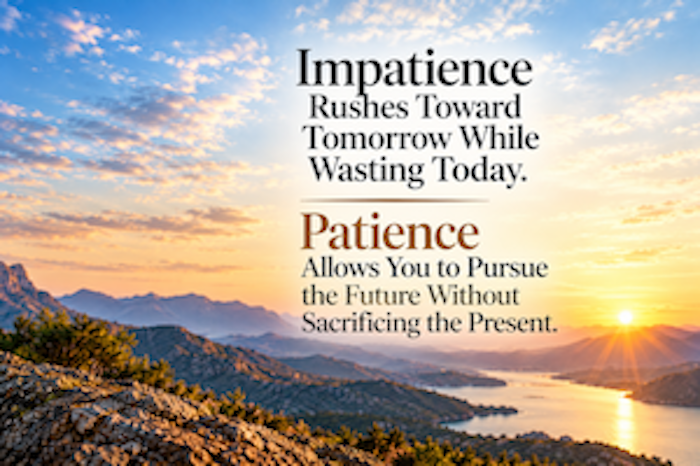
“Impatience rushes toward tomorrow while wasting today. Patience allows you to pursue the future without sacrificing the present.”
The World Has Forgotten How to Wait
We live in a world that has conditioned us to expect almost everything immediately. Information arrives within seconds. Messages demand instant responses. Purchases appear at our doors overnight. Technology promises greater speed, greater convenience, and greater efficiency. Somewhere along the way, we began expecting life itself to operate according to the same timetable.
We want faster results, faster success, faster answers, and faster progress. We want our bodies to transform after a few workouts, our businesses to succeed after a few months, our relationships to deepen without the time required to build trust, and our dreams to materialize before we have fully developed the capacity to sustain them.
There is nothing wrong with wanting progress. Ambition is a powerful force when guided by awareness and purpose. But problems begin when our desire for progress becomes an inability to appreciate the present.
We become so preoccupied with what has not yet happened that we overlook everything that is happening.
And gradually, without realizing it, we begin sacrificing our lives to the future.
Impatience Is More Than Wanting Something Quickly
Impatience is often misunderstood as simply wanting results sooner. But beneath impatience, there is frequently something deeper: discomfort with uncertainty.
We want to know when our efforts will pay off, whether our sacrifices will be rewarded, whether our plans will succeed, and whether the future will unfold as we hope. When those answers are unavailable, the mind begins searching for reassurance.
We check our progress repeatedly. We compare ourselves with others. We question our decisions. We wonder whether we are falling behind. We become frustrated when circumstances refuse to move according to our expectations.
Eventually, impatience begins affecting more than our goals. It affects our relationships, our emotional well-being, our health, and our ability to enjoy ordinary moments.
The irony is that impatience rarely makes the future arrive any sooner.
It simply makes the present more difficult to enjoy.
The Seed Does Not Grow Faster Because You Are Anxious
Imagine planting a seed.
You prepare the soil, place the seed at the proper depth, provide water, ensure adequate sunlight, and create the conditions necessary for growth.
Then nature begins doing what nature does.
You cannot force the seed to grow by digging it up every morning to examine its progress. You cannot demand that its roots develop according to your schedule. You cannot accelerate the seasons simply because you are anxious to see the flowers.
In fact, constantly disturbing the soil may interfere with the very growth you are trying to encourage.
Life works in much the same way.
Whether you are building a business, improving your health, developing a relationship, writing a book, recovering from adversity, or pursuing a meaningful dream, some processes require time.
And not all progress is immediately visible.
Sometimes the most important transformation is happening beneath the surface, where nobody can see it.
The absence of visible results does not always mean the absence of progress.
Patience Is Not Passivity
One of the greatest misconceptions about patience is that it means sitting quietly and waiting for life to happen.
I disagree.
Patience is not the absence of action. It is the ability to act consistently without demanding immediate results.
A patient person can be extraordinarily disciplined, ambitious, and hardworking. They can pursue demanding goals, maintain high standards, and make difficult decisions. What distinguishes patience from impatience is not the amount of effort being invested but the relationship with the time required for that effort to produce results.
Patience understands that meaningful progress often requires commitment, repetition, adjustment, and perseverance.
It does not mean accepting circumstances that need to change. It does not mean tolerating harmful situations indefinitely. And it certainly does not mean abandoning ambition.
Patience is disciplined action combined with emotional steadiness.
It is the willingness to continue doing what matters while allowing the process enough time to unfold.
What Bodybuilding Taught Me About Time
When I reflect on my years in competitive bodybuilding, one of the greatest lessons I learned was that the body does not respond to impatience.
You cannot force muscle development simply because you want to become stronger tomorrow. You cannot replace consistent training with wishful thinking. You cannot ignore recovery, nutrition, sleep, and adaptation while expecting the body to deliver extraordinary results.
Every workout matters, but no single workout creates a champion.
Progress develops through countless repetitions, accumulated effort, intelligent adjustments, and the willingness to remain committed when results appear slow.
There were times when I wanted progress to happen faster. There were moments when I questioned whether I was doing enough. But becoming Mr. Universe required more than physical discipline.
It required patience.
I had to learn to respect the process rather than constantly demand evidence that the process was working.
That lesson extends far beyond the gym.
Whatever you are building in life, you must learn to distinguish between what you can influence and what requires time.
Ambition and Inner Peace Can Coexist
Many people believe that pursuing ambitious goals requires living in a constant state of dissatisfaction. They assume that if they become too comfortable or too content, they will lose their motivation.
But ambition and inner peace are not opposites.
You can want more from life while appreciating what you already have. You can pursue a meaningful dream without allowing that dream to consume every waking moment. You can work diligently toward tomorrow while remaining emotionally available for today.
This is one of the most important distinctions I teach through InnerFitness®.
Your external ambitions should not require the continuous sacrifice of your internal well-being.
You do not have to become miserable in order to become successful.
You do not have to postpone happiness until you achieve a particular goal.
You do not have to reject the present in order to create a better future.
A fulfilling life is not built by choosing between ambition and peace.
It is built by learning how to honor both.
The Trap of “I’ll Be Happy When”
Perhaps one of the most dangerous habits created by impatience is the belief that happiness exists somewhere in the future.
I’ll be happy when I lose the weight.
I’ll be happy when my business succeeds.
I’ll be happy when I earn more money.
I’ll be happy when I find the right relationship.
I’ll be happy when my children are settled.
I’ll be happy when I retire.
There is always another destination.
And when we finally reach one, the mind often creates another.
The problem is not having goals. The problem is making our ability to experience happiness dependent upon reaching them.
If happiness is always waiting at the next destination, we may spend our entire lives traveling without ever feeling that we have arrived.
Patience offers another possibility.
It allows us to recognize that fulfillment can exist within the journey itself.
You can appreciate the process of becoming healthier before reaching your ideal weight. You can enjoy building a business before achieving financial success. You can experience love while a relationship continues developing. You can find meaning in today’s work even when the larger vision remains unfinished.
Happiness does not have to wait for achievement.
Comparison Makes Patience More Difficult
One reason patience has become increasingly difficult is that we are constantly exposed to other people’s visible achievements.
We see their promotions, business successes, transformations, relationships, vacations, and accomplishments. What we rarely see is the uncertainty, sacrifice, preparation, failure, and time that preceded those moments.
We compare our unfinished process with someone else’s celebrated outcome.
And suddenly our own progress feels inadequate.
We begin questioning whether we are moving fast enough, accomplishing enough, or becoming enough.
But life is not a synchronized race.
Different people begin with different circumstances, resources, responsibilities, opportunities, and challenges. Even when two people pursue similar goals, their journeys may unfold at entirely different speeds.
Someone else’s timeline is not a reliable measurement of your worth.
Patience requires the maturity to respect your own process without constantly measuring it against another person’s life.
Some Growth Cannot Be Rushed
There are experiences that simply cannot be accelerated without losing something important.
Trust develops through consistency. Emotional healing often requires time and support. Mastery emerges through repeated practice. Relationships deepen through shared experiences. Wisdom develops through reflection and the integration of life’s lessons.
You cannot demand that someone trust you immediately because you have good intentions. You cannot expect years of conditioning to disappear after a few moments of insight. You cannot become an expert without allowing yourself to be a beginner.
Some things are valuable precisely because of what is required to develop them.
The process is not always an obstacle standing between you and the result.
Sometimes the process is what makes the result meaningful.
Patience Requires Trust, Not Blind Faith
Patience involves trust, but trust should not be confused with blindly assuming that everything will work out exactly as planned.
Sometimes our efforts are not producing the results we expected because our strategy needs to change. Sometimes circumstances have shifted. Sometimes we need better information, additional support, or a different direction.
Patience does not mean ignoring evidence.
It means evaluating evidence without allowing frustration to make every decision.
There is a difference between thoughtfully changing direction and impulsively abandoning something simply because progress feels slow.
Before giving up, ask yourself whether the goal remains meaningful, whether your actions are appropriate, whether you have allowed sufficient time, and whether adjustments could improve the outcome.
The patient mind is not rigid.
It is responsive.
It understands that perseverance and flexibility can exist together.
Impatience Can Damage Relationships
Impatience does not affect only our personal ambitions. It can also influence how we treat the people around us.
We become impatient when someone does not respond quickly enough, when a loved one does not change according to our expectations, when children do not learn something immediately, or when another person processes emotions differently than we do.
We begin demanding that other people operate according to our internal timetable.
But human beings are not projects with guaranteed completion dates.
Relationships require patience because people grow, learn, communicate, and heal at different speeds.
Sometimes the most loving thing you can offer someone is the space to develop without constantly feeling pressured to become who you think they should be.
Patience does not require abandoning boundaries or tolerating repeated disrespect. It requires recognizing the difference between supporting growth and attempting to control it.
Do Not Miss the Life Happening Around You
One of the greatest costs of impatience is not necessarily failure.
It is distraction.
When your attention is constantly directed toward tomorrow, you become less available for today.
You may sit with your family while mentally reviewing unfinished work. You may share a meal with someone you love while worrying about the next responsibility. You may experience a small victory but immediately dismiss it because the larger goal remains incomplete.
You are physically present, but emotionally elsewhere.
And one day, you may realize that the moments you rushed through were the very moments that made your life meaningful.
The conversations.
The laughter.
The quiet mornings.
The friendships.
The ordinary experiences that never seemed important enough to deserve your complete attention.
The future matters.
But so does the life unfolding while you pursue it.
Patience Is a Form of Emotional Strength
We often associate strength with action, speed, intensity, and the ability to push through difficulty.
But patience requires another kind of strength.
It requires the ability to tolerate uncertainty without becoming consumed by it. It requires emotional regulation when circumstances move slowly. It requires self-discipline when results are not immediately rewarding.
Patience is not weakness.
It is not indecision.
It is not a lack of urgency.
It is the capacity to remain committed without allowing every delay to disturb your inner peace.
A patient person can act decisively when action is required and remain still when waiting is wiser.
That flexibility is a form of mastery.
Learn to Recognize Invisible Progress
Not all progress announces itself through measurable achievements.
Sometimes progress is the conversation you handled with greater patience. Sometimes it is the temptation you resisted, the healthier choice you made, or the moment you responded thoughtfully instead of reacting impulsively.
Sometimes progress is learning to rest without guilt.
Sometimes it is becoming more comfortable with uncertainty.
Sometimes it is recognizing that you no longer respond to situations the way you once did.
These changes may not attract applause or recognition.
But they matter.
Growth is not always about what you accomplish externally.
It is also about who you are becoming internally.
And patience allows you to appreciate both.
The Wisdom of Knowing When to Wait and When to Act
Patience is not simply waiting longer.
It is knowing how to relate wisely to time.
There are moments when waiting is appropriate because something needs time to develop. There are other moments when waiting becomes avoidance, and the most responsible decision is to act.
A difficult conversation may need to happen now. An unhealthy situation may require immediate change. A failing strategy may need adjustment. An opportunity may demand timely action.
Wisdom lies in recognizing the difference.
Impatience often pushes us to act because we are uncomfortable.
Avoidance encourages us to wait because we are afraid.
Patience allows us to choose based on awareness rather than emotional pressure.
Sometimes patience means continuing.
Sometimes it means adjusting.
Sometimes it means allowing.
And sometimes it means having the courage to change direction.
Reflective Question
Are you so focused on where you want to be that you are overlooking the value of where you are today?
Consider the goals you are pursuing, the expectations you have created, and the pressure you may be placing upon yourself. Are you taking meaningful action while allowing time for results to develop, or are you repeatedly disturbing your own peace because life is not moving according to your preferred schedule?
Call to Action
For the next seven days, practice what I call patient ambition. Choose one meaningful goal and identify the actions that are genuinely within your control. Commit to those actions consistently, but stop demanding immediate evidence that everything is working.
At the end of each day, acknowledge one action you completed, one lesson you learned, and one moment you appreciated. When impatience appears, pause and ask whether there is something useful you can do now or whether the situation simply requires more time.
Continue pursuing your future, but make a deliberate commitment not to sacrifice the present while doing so.
Final Reflection
Life is not asking you to abandon your dreams.
It is not asking you to become less ambitious, less disciplined, or less committed to the future you want to create.
It is asking you to recognize that the journey is part of your life—not merely an inconvenience you must endure before your life can begin.
There will always be something you are working toward. Another goal. Another opportunity. Another milestone. Another chapter you hope to experience.
But if you spend every day impatiently waiting for the next chapter, you may overlook the beauty, wisdom, and meaning of the one you are living.
Keep moving forward.
Keep planting seeds.
Keep nurturing what matters.
Keep showing up with discipline, courage, and commitment.
But allow yourself to appreciate the small victories, the ordinary moments, and the people who share the journey with you.
Remember that meaningful growth often takes place long before visible results appear.
And remember that your peace does not need to depend upon how quickly life responds to your expectations.
Impatience rushes toward tomorrow while wasting today. Patience allows you to pursue the future without sacrificing the present.
The goal is not to slow down your dreams.
The goal is to stop sacrificing your life while pursuing them.
Because the future you are working so hard to create should not come at the expense of the present you will never have again.
Nordine Zouareg THE NO-LIMITS LIFE™ InnerFitness® — Transforming Lives from the Inside Out™