
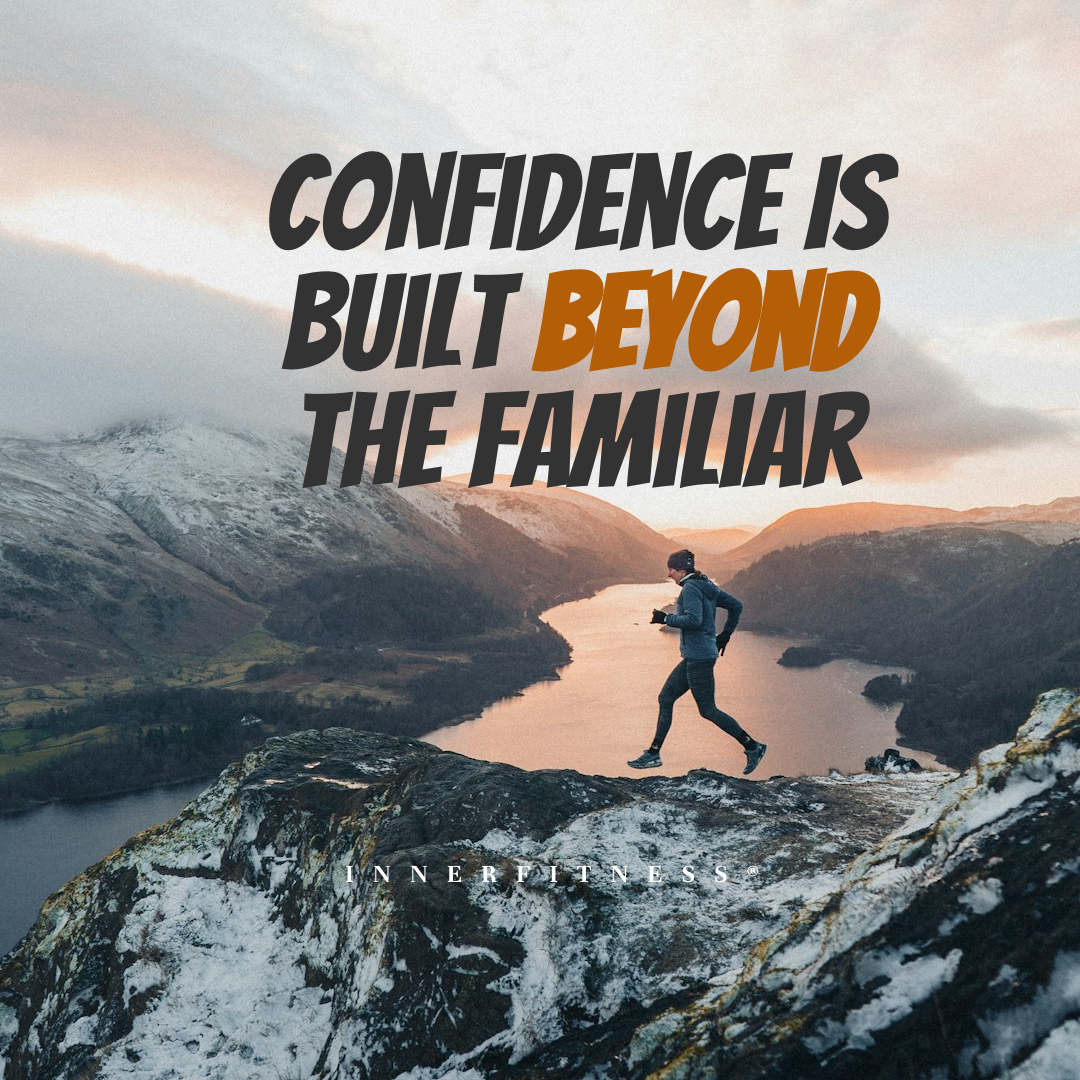
Confidence Is Built Beyond the Familiar
- Blog, Emotional, Life
- By NordineZouareg
Strip away the comfort of what you already know, and walk boldly into every arena of life.
The Invisible Fences We Build Around Ourselves
Most people spend far more of their lives inside invisible fences than they realize. These fences are rarely built by reality. They are built by familiarity—by what we already know, what we already do well, the people we already understand, and the environments in which we already know how to function.
The familiar feels safe because it is predictable. We know the rules. We understand what is expected of us. We know how to behave and, perhaps most importantly, we already possess an identity within that environment. We know who we are there.
There is nothing inherently wrong with familiarity. We all need stability. We need routines, relationships, and environments that provide a sense of grounding. But familiarity becomes dangerous when we begin mistaking comfort for growth.
You can become extremely comfortable while remaining completely stagnant.
Growth eventually asks a question comfort would rather avoid:
Who might you become if you were willing to leave behind what you already know?
Comfort and Growth Are Rarely Roommates for Long
There are seasons when comfort is necessary. After tremendous stress, loss, illness, or adversity, we may need stability and restoration. Life does not require us to constantly live at the edge of our capacity.
But meaningful transformation eventually requires movement.
You cannot discover a new world while refusing to leave the old one.
Every significant transformation in my own life required stepping into something I did not completely understand. Whether it was competition, moving to another country, rebuilding my life, working with extraordinary people, writing books, speaking, coaching, or creating something that had not existed before, certainty was rarely waiting for me at the beginning.
There were questions.
There was discomfort.
There were moments of doubt.
There were times when I had to become a beginner again.
Looking back, however, those were often the experiences that expanded me the most.
The familiar confirms who you already are.
The unfamiliar introduces you to who you might become.
The Ego Prefers Competence
One of the greatest obstacles to growth is not always fear.
Sometimes it is the ego.
The ego enjoys environments in which it already knows how to succeed. It likes competence. It likes recognition. It likes knowing the answer. It likes being respected for what it already knows.
Growth threatens that identity because growth frequently requires becoming a beginner.
Suddenly, you do not know everything.
You may ask basic questions.
You may make mistakes.
Someone younger than you may know more about something than you do.
You may temporarily appear less capable than the identity you have spent years building.
For the ego, that can feel threatening.
It would sometimes rather remain impressive in a small world than become inexperienced in a larger one.
But if you constantly need to be the person who knows the most in the room, eventually you will stop entering rooms capable of teaching you anything.
Humility is not the enemy of confidence.
It is one of the foundations of growth.
Confidence Is Not Knowing You Will Succeed
We often misunderstand confidence.
We imagine confidence as certainty: I know I can do this. I know I will succeed. I know everything will work out.
But life rarely offers those guarantees.
Real confidence is something deeper.
Confidence is being able to say:
“I don’t know exactly what will happen, but I trust myself enough to find out.”
That is a very different kind of strength.
It does not require certainty about the outcome. It requires trust in your ability to respond to whatever the outcome becomes.
You may succeed.
You may struggle.
You may discover that you need more preparation.
You may fail and need to begin again.
But confidence says that none of those possibilities has the authority to define your worth.
That kind of confidence cannot be developed through thinking alone.
It must be earned through experience.
Confidence Is Built Through Movement
Many people wait until they feel confident before taking action.
They tell themselves, When I feel ready, I will begin.
But readiness often does not arrive first.
Action does.
You step forward while uncertain.
You attempt something before you feel completely prepared.
You make mistakes.
You adjust.
You learn.
You try again.
And somewhere in that process, something changes inside you.
You realize:
I survived that.
I learned from that.
I handled something I once thought was beyond me.
Perhaps I am capable of more than I believed.
That is how confidence grows.
Not through repeatedly telling yourself that you are capable, but through accumulating evidence that you can enter uncertainty and respond effectively.
Confidence is rarely born sitting still.
It is built through movement.
Growth Demands Exposure
If you want to expand your life, you must expand what you expose yourself to.
New ideas challenge assumptions you did not realize you had.
New conversations reveal perspectives you have never considered.
New cultures remind you that your way of seeing the world is not the only way.
New disciplines expose weaknesses and abilities you did not know existed.
New failures reveal where growth is still required.
New environments force you to adapt.
New people introduce you to possibilities that might never have appeared within your existing circle.
This is why exposure is so important to human development.
Every environment reflects something back to you.
Comfort shows you what you have mastered.
Challenge shows you what remains undiscovered.
Every Arena Has Something to Teach You
Life is filled with classrooms that do not look like classrooms.
The gym teaches discipline because results cannot be negotiated. The body responds to what you repeatedly do, not what you occasionally intend to do.
Business teaches resilience because plans change, markets shift, people disappoint you, ideas fail, and success frequently requires adapting faster than circumstances change.
Love teaches vulnerability because genuine connection eventually requires allowing another person to see parts of you that strength alone cannot protect.
Loss teaches perspective because it reminds us how temporary so much of what we take for granted really is.
Travel teaches humility because stepping into another culture reminds us that our habits, assumptions, and ways of thinking are not universal truths.
Silence teaches awareness because when external noise disappears, we begin hearing what has been happening internally.
Adversity teaches strength because it forces us to discover capacities we might never have needed under easier circumstances.
Every arena carries a lesson.
The more arenas you courageously enter, the more complete your understanding of yourself can become.
You Need Experiences That Challenge Your Identity
There is a subtle danger in becoming too attached to who you believe you are.
We begin creating sentences such as:
I’m not a businessperson.
I’m not athletic.
I’m not creative.
I’m not good with people.
I’m too old to begin.
I’ve never been adventurous.
I’m not someone who takes risks.
Repeat an identity long enough and it becomes an invisible instruction manual for your life.
You stop considering opportunities that contradict the story.
But identities are not always truths.
Sometimes they are simply conclusions based on limited experience.
You may believe you are not capable of something because you have never placed yourself in an environment where that capacity could emerge.
The person you believe yourself to be today is partly the result of the experiences you have already had.
Imagine who you might become through experiences you have not yet allowed yourself to have.
Do Not Allow Success to Become Another Comfort Zone
Failure is not the only thing that can keep us stuck.
Success can do it too.
Once you become good at something, people recognize you for it. Your reputation grows. Your identity becomes connected to your expertise. Eventually, trying something new becomes psychologically expensive because you may temporarily lose the feeling of mastery.
This is why successful people sometimes stop evolving.
They become prisoners of what they are already known for.
But yesterday’s success should be a foundation, not a cage.
Everything you have learned should give you greater courage to explore—not greater fear of appearing inexperienced.
There is extraordinary freedom in being willing to say:
“I don’t know, but I am willing to learn.”
Those words keep possibility alive.
Failure Is Tuition for Expansion
If you are genuinely expanding your life, you will eventually fail at something.
That is not pessimism.
It is mathematics.
When you repeatedly attempt things beyond your current ability, some attempts will not work.
The question is not whether you will experience failure.
The question is what meaning you assign to it.
If failure means I am not capable, you retreat.
If failure means I have discovered something I still need to learn, you grow.
Every failure contains information.
Perhaps your strategy was wrong.
Perhaps your timing was wrong.
Perhaps you need more knowledge.
Perhaps you need another attempt.
Perhaps the direction itself needs to change.
Failure becomes destructive when ego turns information into identity.
You failed is an event.
You are a failure is a story.
Learn to separate the two.
Curiosity Is One of the Greatest Forms of Courage
We often associate courage with dramatic acts.
But curiosity requires courage too.
Curiosity says, What else might be possible?
What don’t I understand?
What could this person teach me?
What happens if I try?
What assumption am I willing to question?
Curiosity keeps the mind flexible. It prevents certainty from hardening into limitation.
A curious person can enter an unfamiliar environment without needing to immediately dominate it. They observe. They listen. They ask. They absorb. They experiment.
Curiosity gives you permission not to know.
And once you stop needing to appear certain, you become far more available for transformation.
Stop Waiting Until You Feel Ready
There is a seductive promise hidden inside the phrase when I’m ready.
It makes postponement sound responsible.
Sometimes preparation is necessary. You should educate yourself, assess risks, and prepare intelligently.
But there comes a point when additional preparation becomes another form of avoidance.
You cannot prepare yourself into certainty.
Eventually, you must move.
Think about learning to swim. You can study technique, watch videos, understand breathing patterns, and observe swimmers for years.
Eventually, you have to enter the water.
Life works much the same way.
Some knowledge can only be acquired through participation.
Some confidence can only be developed after action.
Some questions can only be answered by living them.
Your Voice Can Shake and You Can Still Move
Courage does not always look courageous from the inside.
Sometimes courage feels like fear.
Your heart races.
Your mind produces doubts.
Your voice shakes.
You wonder whether you belong.
And you move anyway.
Do not make the mistake of believing that confident people never experience uncertainty. Some of the most courageous people I have known feel fear very deeply.
They simply stopped allowing fear to make every decision.
You do not need fear’s permission to move forward.
You do not need perfect confidence.
You need enough courage for the next step.
Then another.
Then another.
Eventually, the path behind you becomes evidence of what you are capable of surviving, learning, and becoming.
Your Potential Lives Beyond Familiarity
There is a version of you that your current life may never require you to become.
Think about that.
There may be strengths inside you that comfort will never demand.
There may be leadership you have never needed to demonstrate.
There may be creativity you have never needed to access.
There may be courage you have never needed to summon.
There may be compassion, resilience, adaptability, discipline, and wisdom waiting inside circumstances you have not yet entered.
We often ask, Who am I?
Perhaps another powerful question is:
“Who have I not yet given myself the opportunity to become?”
Potential cannot be fully discovered through imagination.
It requires exposure.
Life Is Movement
Look at nature.
Seasons change.
Rivers move.
Bodies adapt.
Trees grow toward available light.
Nothing alive remains exactly as it was.
Yet human beings sometimes attempt to build permanent identities inside an impermanent world.
We cling to old beliefs, old environments, old relationships, old routines, and old versions of ourselves because familiarity creates the illusion of security.
But life continues moving whether we move with it or not.
You are not meant to remain exactly who you were five years ago.
You are not even required to remain who you were one year ago.
Growth gives you permission to revise yourself.
You can change your mind.
You can learn something new.
You can admit that an old belief no longer serves you.
You can enter a different arena.
You can begin again.
The Greater Risk
People often focus on the risk of leaving what is familiar.
What if I fail?
What if people judge me?
What if I make the wrong decision?
What if I discover I’m not good enough?
Those are legitimate questions.
But there is another risk we rarely examine:
What if you never go?
What if you spend decades protecting yourself from uncertainty and eventually realize you protected yourself from possibility as well?
What if fear keeps you so safe that you never discover your strength?
Perhaps one of life’s greatest tragedies is not failure.
Perhaps it is reaching the end of your life having explored only a small fraction of who you could have become because fear convinced you to remain where everything felt familiar.
Reflective Question
Where in your life have you mistaken familiarity for safety—and safety for growth?
Look at your career, relationships, health, creativity, beliefs, friendships, environment, and dreams. Where have you become so comfortable knowing who you are that you have stopped discovering who else you could become?
Call to Action
Choose one unfamiliar arena and deliberately step into it. It does not need to be dramatic. Start the conversation. Take the class. Visit the place. Learn the skill. Ask the question. Enter the room where you are not the expert. Meet someone whose life experience differs from yours. Attempt something you have quietly told yourself you cannot do.
Do not demand that you feel confident first.
Take action and allow confidence to follow.
When discomfort appears, do not automatically interpret it as a warning to retreat. Sometimes discomfort simply means you have reached the edge of what you already know.
Take another step.
Final Reflection
Confidence is not built by arranging life so that nothing can surprise you.
It is built by discovering that when life surprises you, you can respond.
It is not knowing every answer.
It is trusting yourself when you do not.
It is not eliminating uncertainty.
It is becoming stronger in its presence.
Strip away the comfort of what you already know and walk boldly into every arena of life. Enter rooms where you still have something to learn. Meet people who challenge the boundaries of your thinking. Explore cultures that expand your understanding. Attempt things that remind you what it feels like to be a beginner.
Fail occasionally.
Learn constantly.
Adapt willingly.
Remain curious.
Your current identity is not your final identity.
Your present capacity is not your ultimate capacity.
Your past experience is not the boundary of your future possibility.
There are still parts of you waiting to be discovered.
But they will not necessarily come looking for you inside the familiar.
You may have to go meet them.
Even if your voice shakes.
Even if certainty disappears.
Even if nobody understands your journey yet.
Walk toward what challenges you.
Walk toward what expands you.
Walk toward what requires you to become more than you are today.
Because confidence is not something you wait to possess before entering the unknown.
Confidence is what you build by entering the unknown and discovering that you can find your way.
And perhaps every extraordinary life begins the same way:
With someone willing to leave the known behind.
Nordine Zouareg
THE NO-LIMITS LIFE™
InnerFitness® — Transforming Lives from the Inside Out™
Order The No-Limits Life Book (Available NOW!)
Be a part of the Beta version of the InnerFitness® App
Facebook
Twitter
LinkedIn
WhatsApp
Email