
A Negative Thought Is Not the Problem
- Health, Mental, Spiritual, Wellness
- By NordineZouareg
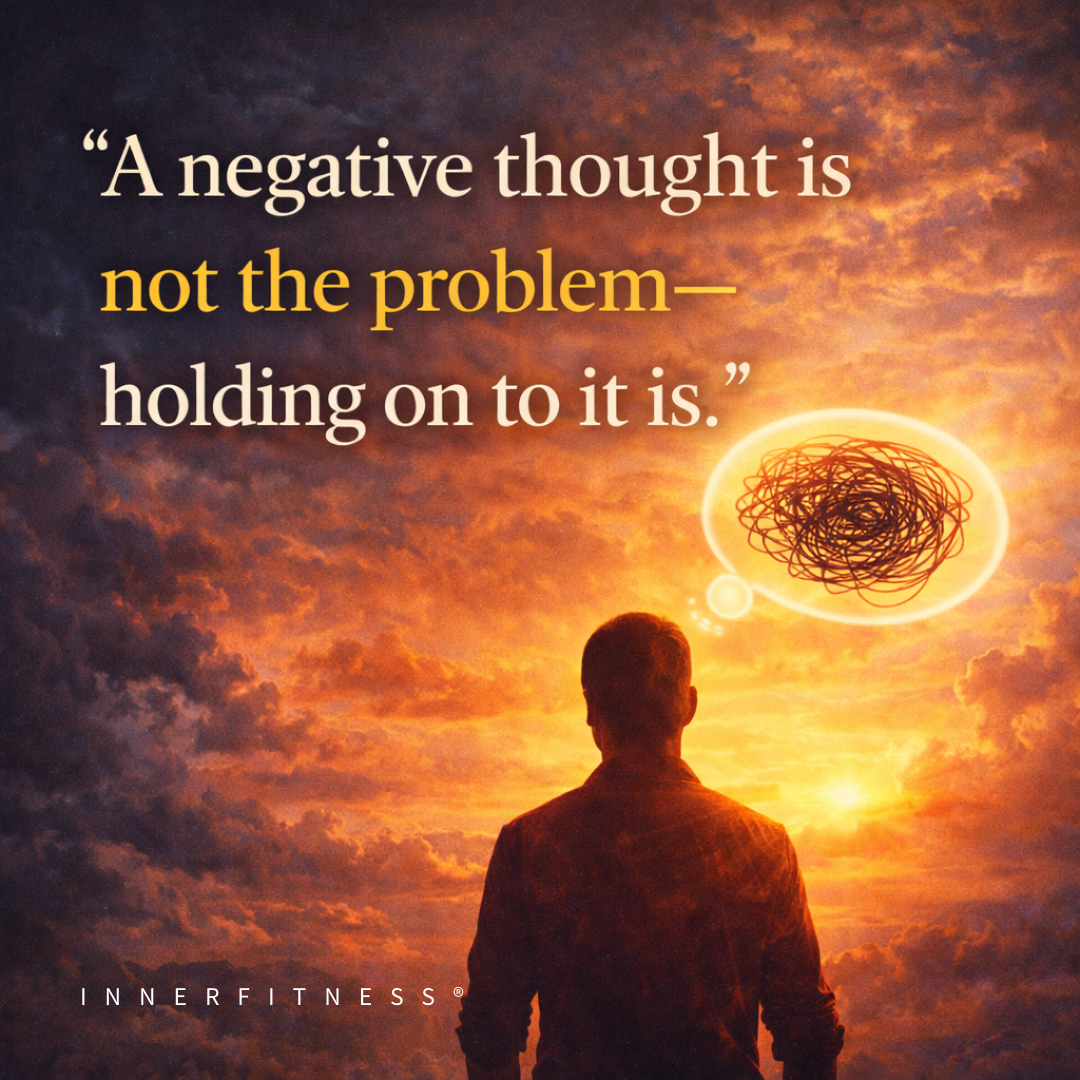
“A negative thought is not the problem—holding on to it is.”
This simple sentence contains a powerful truth about the human mind.
Many people spend years trying to eliminate negative thinking entirely. They believe that peace of mind requires a perfectly positive mental landscape—no doubt, no fear, no critical thoughts. But that expectation misunderstands how the mind works.
Negative thoughts are not a malfunction of the mind.
They are part of being human.
Thoughts arise continuously, just as breath rises and falls or the heart beats without effort. The mind generates impressions, interpretations, worries, hopes, memories, and predictions all day long. Some of these thoughts are useful. Some are neutral. And some are negative.
The problem is not that these thoughts appear.
The problem begins when we grab hold of them and refuse to let them go.
The Natural Activity of the Mind
The mind is an incredible instrument.
It scans for danger.
It analyzes situations.
It anticipates outcomes.
This ability helped our ancestors survive. If you lived thousands of years ago, your brain needed to constantly scan the environment for threats—predators, unstable ground, hostile tribes.
Negative thinking, in that context, had a survival purpose. It prepared the body to respond quickly.
But modern life is very different from the environments our brains evolved to navigate.
Today, the “threats” our mind reacts to are often psychological rather than physical:
A conversation that might go badly.
A mistake we made yesterday.
A future outcome we fear.
An imagined judgment from others.
The mind reacts to these situations with the same intensity it once reserved for genuine survival threats.
And that reaction produces negative thoughts.
Again, this is natural.
The mind is doing what it was designed to do.
When a Thought Becomes a Story
The real difficulty begins when we treat a thought as truth.
A negative thought appears:
“I’m not good enough.”
On its own, this is simply a thought—one momentary mental event among thousands that occur during the day.
But when we hold on to it, something changes.
We begin feeding the thought attention.
We analyze it.
We replay it.
We attach evidence to it.
Before long, that single thought grows into a story.
The mind starts connecting it to past experiences:
“Remember when that project failed?”
“Remember when someone criticized you?”
“Remember when things didn’t work out?”
Now the thought is no longer a passing cloud.
It has become a narrative.
And that narrative begins shaping how we see ourselves and the world around us.
The Birth of the Mental Prison
When negative thoughts are repeated and reinforced, they begin to define perception.
You start interpreting events through that lens.
A neutral comment from a colleague becomes criticism.
A temporary setback becomes proof of incompetence.
A difficult day becomes evidence that life is against you.
Over time, the story grows stronger.
What began as a fleeting thought becomes a belief.
And belief becomes identity.
This is how a momentary thought can turn into a mental prison.
But the prison is not built by the thought itself.
It is built by our attachment to it.
The Power of Awareness
Awareness changes everything.
The moment you recognize that a thought is simply a thought—not a fact, not a prophecy, not an identity—you create space between yourself and the thought.
That space is freedom.
Without awareness, we become absorbed in every thought the mind produces.
With awareness, we can observe the mind instead of becoming trapped inside it.
Instead of saying:
“I am a failure.”
We can notice:
“A thought about failure has appeared.”
That difference may seem subtle.
But it transforms your relationship with your own mind.
Observing Instead of Absorbing
When you learn to observe your thoughts, something remarkable happens.
You begin to see that the mind produces thousands of thoughts every day.
Many of them contradict each other.
In the morning, the mind might say:
“This is going to be a great day.”
Later, it might say:
“Everything is going wrong.”
Both thoughts cannot be absolute truth.
They are simply mental events.
Observing thoughts instead of absorbing them allows you to experience them without being controlled by them.
You become the witness rather than the prisoner.
Attention Is the Fuel
Thoughts survive on attention.
The more attention you give them, the stronger they become.
This is why holding on to negativity gives it power.
When you replay a negative thought repeatedly, your brain reinforces the neural pathway associated with it.
The thought becomes more familiar.
And familiarity makes it easier for the mind to produce the same thought again.
But when you release the thought—when you acknowledge it without feeding it—something different happens.
The thought dissolves.
Like a wave returning to the ocean.
Letting Thoughts Pass
Imagine standing beside a river.
Leaves float along the surface of the water.
Each leaf represents a thought.
If you jump into the river to grab every leaf, you will quickly become exhausted.
But if you stand on the shore and simply watch the leaves pass, the river continues flowing without difficulty.
Your mind works the same way.
Thoughts appear.
They pass.
New ones replace them.
You do not have to chase every leaf.
Emotional Resilience
A person who learns to observe their thoughts without clinging to them develops emotional resilience.
They understand that not every thought deserves attention.
And certainly not every thought deserves belief.
This understanding creates stability.
Difficult thoughts may still appear, but they do not control the inner environment.
The mind becomes quieter.
Clearer.
More balanced.
Peace is no longer dependent on controlling every thought.
Peace comes from knowing that thoughts cannot define you unless you allow them to.
A Different Relationship With Negativity
Letting go of negative thoughts does not mean ignoring reality.
It does not mean pretending life is always positive.
Difficult emotions are part of human experience.
Fear, disappointment, frustration, and grief all have important roles. They can signal that something needs attention, reflection, or change.
But acknowledging an emotion is different from becoming trapped in it.
Healthy awareness allows you to say:
“This thought is present.”
“This emotion is present.”
Without concluding:
“This is who I am.”
“This is my permanent reality.”
That distinction is powerful.
The Discipline of Release
Letting go of negative thoughts is a skill.
And like any skill, it improves with practice.
Each time you notice a thought and release it instead of clinging to it, you strengthen your ability to remain calm and centered.
Over time, the mind learns a new pattern.
Instead of spiraling into negativity, it returns to balance more quickly.
This is not suppression.
It is mastery.
Peace Is Not the Absence of Thoughts
Many people believe that peace requires a completely silent mind.
But the mind is naturally active.
Trying to force it into silence often creates more tension.
True peace does not come from eliminating thoughts.
It comes from recognizing that you are not your thoughts.
Thoughts come and go.
Awareness remains.
When you rest in that awareness, the mind loses its ability to dominate your inner world.
Returning to the Present
One of the simplest ways to release a negative thought is to return to the present moment.
Notice your breath.
Feel your body.
Observe your surroundings.
The present moment rarely contains the catastrophic scenarios that negative thinking imagines.
Those scenarios live in the past or the future.
Presence dissolves many of the illusions the mind creates.
The Freedom of Perspective
When you stop holding on to negative thoughts, your inner world becomes lighter.
Clarity replaces confusion.
Perspective replaces reaction.
You begin to see situations more accurately.
You realize that many thoughts were never facts to begin with.
They were simply passing impressions.
And impressions do not define reality.
Call to Action
Today, pay attention to one negative thought that appears in your mind.
Instead of fighting it or believing it, simply notice it.
Say quietly to yourself:
“That is a thought.”
Then allow it to pass.
Do not analyze it.
Do not feed it.
Just observe it leaving.
Practice this several times during the day.
You may discover that the mind becomes calmer—not because thoughts disappear, but because you are no longer holding on to them.
Final Reflection
A negative thought is not the problem.
Holding on to it is.
Thoughts will always appear. That is the nature of the mind.
But you are not required to believe every thought you think.
You are not required to carry every mental story the mind produces.
Peace begins the moment you recognize that thoughts are temporary visitors—not permanent residents.
And the moment you stop holding on…the mind learns how to let go.
Disclaimer
This article is meant to inspire reflection and promote wellbeing. It is not a substitute for professional medical or mental health advice. If you or someone you know is struggling with insomnia, stress, or emotional distress, please seek help from a qualified healthcare or mental health professional. Remember: asking for help is an act of courage and self-care.
— Nordine Zouareg | InnerFitness® — Transforming Lives from the Inside Out™
Pre-0rder The No-Limits Life Book
Facebook
Twitter
LinkedIn
WhatsApp
Email