
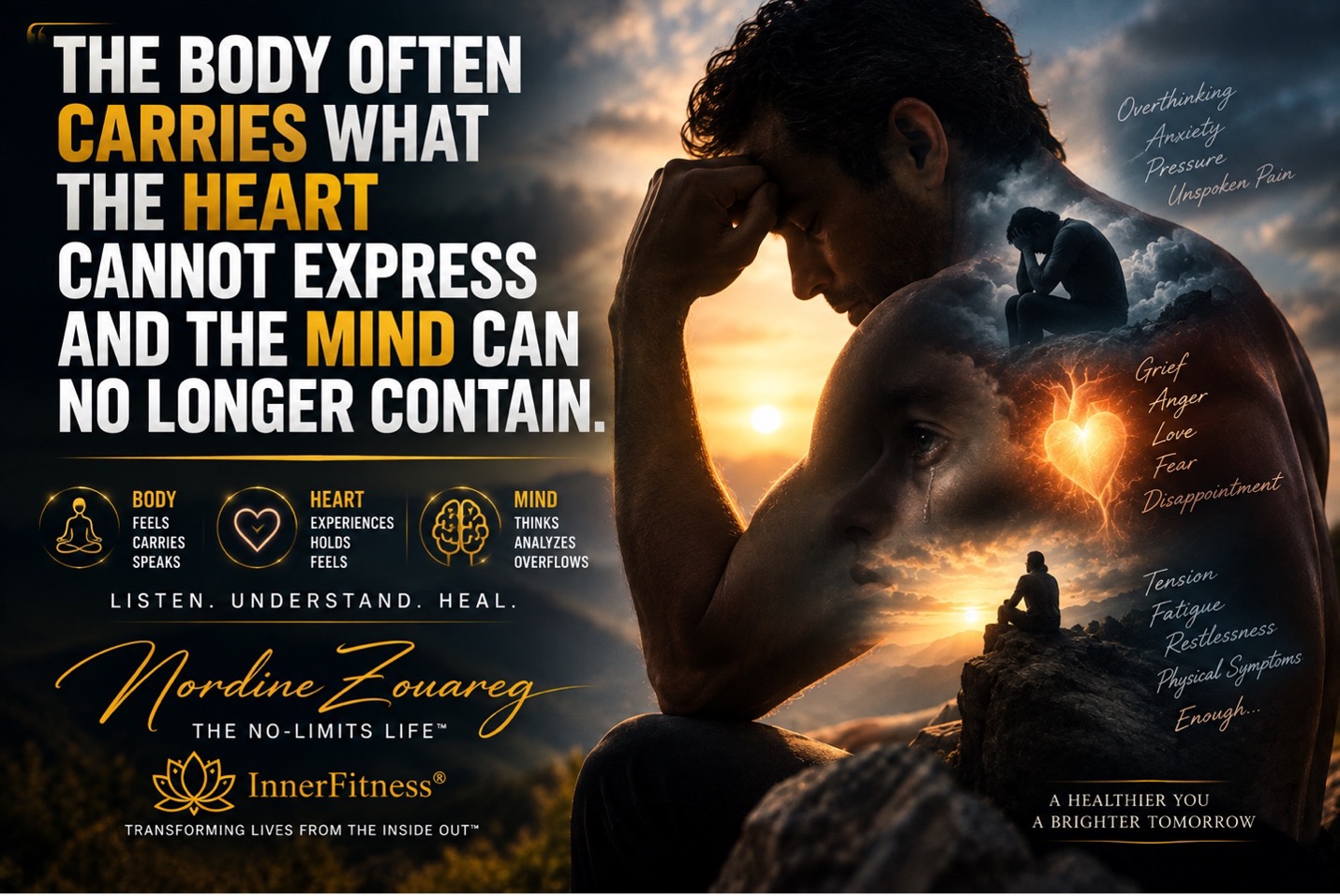
“The body often carries what the heart cannot express and the mind can no longer contain.”
We Are Not Separate Parts
We sometimes think of the body, mind, and emotions as though they operate independently. We take care of the body through exercise and nutrition, address the mind through learning and problem-solving, and deal with emotions only when they become impossible to ignore. But the human being does not function in separate compartments. We are an interconnected system. What affects the mind can influence the body. What wounds the heart can affect how we think, sleep, breathe, relate, and move through the world.
This is why I have always believed that true wellness must address the whole person. You cannot continually neglect your emotional life and assume the rest of you will remain untouched. You may be extraordinarily disciplined physically and highly functional professionally, yet still be carrying an enormous emotional burden underneath everything you do. The outside may look strong while the inside is asking desperately for attention.
“I’m Fine” Can Become a Dangerous Habit
How many times have you said, “I’m fine,” when you knew you weren’t? Someone asks how you are doing, and the answer comes automatically. You smile, continue working, take care of your responsibilities, answer the emails, attend the meetings, help everyone else, and convince yourself that because you are still functioning, you must be handling everything well.
But functioning and healing are not the same thing.
Human beings can become remarkably skilled at carrying pain while appearing perfectly composed. We learn to suppress anger because we don’t want conflict. We hide grief because we don’t want to appear vulnerable. We swallow disappointment because other people depend upon us. We ignore fear because we believe strength means never admitting that we are afraid.
Eventually, “I’m fine” can become less of an answer and more of an emotional hiding place.
What We Suppress Does Not Simply Disappear
Emotions are not weaknesses that need to be eliminated. They are part of the information system of being human. Anger can tell us that something feels unjust or that a boundary has been crossed. Grief tells us that something mattered deeply. Fear can alert us to uncertainty or danger. Sadness may ask us to slow down, process a loss, or acknowledge something we have been trying to avoid.
When we repeatedly refuse to acknowledge these experiences, they do not necessarily vanish simply because we have decided not to think about them. Stress and emotional strain can affect how we experience our bodies, including our sleep, muscle tension, breathing, energy, and ability to relax. At the same time, physical symptoms can have many medical causes and should never automatically be assumed to be emotional.
The point is not to blame every physical problem on the mind. The point is to stop pretending that our inner lives and physical lives have nothing to do with one another.
When the Body Begins Asking for Attention
Sometimes the first indication that we are carrying too much is not a thought. It is a sensation. We notice that our shoulders are constantly tense. Our jaw remains clenched without realizing it. Our breathing becomes shallow. Sleep becomes difficult. We feel restless even when there is nothing immediate we need to do. We wake exhausted despite spending hours in bed. Or we simply experience an overwhelming sense that our entire system is saying, Enough.
These experiences deserve appropriate attention, particularly when they are persistent, severe, or new. Caring for yourself means being willing to seek professional medical or mental-health support when needed rather than assuming you should simply endure what you are experiencing.
But caring for yourself also means becoming curious. Alongside asking what may be happening physically, there is another question worth considering: What has been happening in my life?
Sometimes the body reminds us to pay attention to a burden we have normalized.
Ask What You Have Been Carrying
We become so accustomed to asking, “What is wrong with me?” that we overlook a much more compassionate question: “What have I been carrying?”
Perhaps you have been carrying grief you never gave yourself permission to experience. Perhaps you have been swallowing anger because speaking honestly might create conflict. Perhaps there is a conversation you have postponed for months or years. Perhaps you have normalized a level of professional pressure that would once have seemed unbearable. Perhaps you have spent so much time caring for everyone around you that you have forgotten what it feels like to care for yourself.
Maybe nothing is “wrong” with you in the way you fear.
Maybe something simply needs your attention.
That distinction matters because judgment closes us down while curiosity opens us up.
Strength Is Not Emotional Silence
Many of us were taught a distorted definition of strength. We learned that strong people endure silently, remain composed, solve their own problems, and never allow emotions to interfere with responsibility. For some, this becomes an identity. They become the person everyone else depends upon, and eventually they feel they have nowhere to place their own pain.
But strength is not the absence of emotion.
Strength is having the courage to experience emotion without allowing it to destroy you or define you.
There is tremendous courage in saying, “This hurt me.” There is strength in admitting, “I am overwhelmed.” There is maturity in recognizing, “I need help.” There is wisdom in understanding that carrying everything alone is not proof of resilience.
Sometimes the strongest thing you can do is put something down.
Emotional Honesty Changes the Relationship With Yourself
Healing often begins with honesty. Not dramatic confession. Not endless analysis. Simply telling yourself the truth about what you are experiencing.
I am angry.
I am grieving.
I am disappointed.
I am afraid.
I am exhausted.
I miss someone.
I need help.
There is something profoundly liberating about naming an emotion without judging yourself for having it. Once you acknowledge what is happening, you can begin deciding what it needs. Some emotions need expression. Some need understanding. Some require action. Others simply need enough time and space to move through you.
You cannot meaningfully address what you continually refuse to acknowledge.
Give Your Heart Somewhere to Speak
Different people process emotions differently. For one person, healing may begin through a conversation with someone they trust. For another, it may come through journaling, prayer, meditation, time in nature, or professional counseling. Sometimes we need to cry. Sometimes we need silence. Sometimes we need movement. Sometimes we need rest. Sometimes we need to finally have the difficult conversation we have rehearsed privately a thousand times.
The method matters less than the willingness to stop running from yourself.
Give your inner life somewhere safe to speak.
You do not need to turn every emotion into a crisis. You simply need to stop treating every uncomfortable emotion as an intruder that must immediately be suppressed.
What you feel is part of your experience.
Listen to it.
Rest Is Not a Reward for Breaking Down
One of the most damaging habits in modern culture is treating rest as something we earn only after exhaustion. We push until the body forces us to stop and then call the collapse recovery.
Rest should not require a crisis.
Your body needs recovery before it reaches depletion. Your nervous system needs periods when it is not being bombarded by demands. Your mind needs silence. Your emotions need space that is not immediately occupied by another task, another screen, another conversation, or another obligation.
Rest is not laziness.
It is maintenance.
Athletes understand that muscles do not become stronger during the workout alone; recovery is part of adaptation. Human beings are no different. We require periods of restoration if we expect ourselves to continue functioning with clarity, strength, and emotional stability.
Listen Without Becoming Afraid
Listening to your body does not mean becoming hypervigilant about every sensation. Awareness should create a healthier relationship with yourself, not another source of anxiety. The goal is not to interpret every headache, tense muscle, or difficult night of sleep as evidence of some hidden emotional crisis.
The goal is simply to become attentive.
Notice patterns. Respect persistent symptoms. Seek appropriate care when something concerns you. At the same time, remain curious about the broader context of your life. Are you sleeping enough? Are you constantly stressed? Are you moving your body? Are you carrying unresolved conflict? Have you experienced a significant loss? Are you giving yourself any opportunity to recover?
Awareness allows us to respond rather than panic.
The Body Is Not Your Enemy
People sometimes develop an adversarial relationship with their bodies. They become frustrated when the body becomes tired, changes with age, needs rest, experiences discomfort, or refuses to perform exactly as demanded. They treat the body like a machine that has failed them.
But your body is not your enemy.
It has carried you through every chapter of your life. It has adapted to extraordinary demands. It has allowed you to work, love, travel, create, embrace the people you care about, recover from setbacks, and experience the physical world around you.
Perhaps instead of constantly asking your body to do more, occasionally ask what it needs from you.
That simple shift—from command to relationship—can change how you approach wellness entirely.
Healing From the Inside Out
For decades, my philosophy of InnerFitness® has been rooted in a simple understanding: meaningful transformation cannot be reduced to the exterior. A strong body matters. Nutrition matters. Exercise matters. Sleep matters. But so do your thoughts, emotional patterns, relationships, sense of purpose, and connection with yourself.
We cannot separate the person into pieces and expect lasting wellness.
Sometimes becoming healthier means lifting weights.
Sometimes it means eating differently.
Sometimes it means sleeping.
And sometimes it means forgiving, grieving, speaking, releasing, asking for help, or finally acknowledging something your heart has been carrying for years.
That is why transformation must happen from the inside out.
Reflective Question
If your body could speak to you clearly today—not with fear or judgment, but with wisdom—what might it be asking you to finally acknowledge, express, change, or release?
Call to Action
Give yourself a few quiet minutes today without your phone, television, work, or distractions. Notice your breathing and where you are holding tension. Then ask yourself one question: What have I been carrying that I have not allowed myself to fully acknowledge? You do not need to solve everything today. Begin by listening. If something physical or emotional has been persistent or concerning, give yourself permission to seek the appropriate professional support as part of caring for the whole person.
Final Reflection
We spend enormous amounts of energy trying to appear strong. We continue working, smiling, producing, helping, and telling everyone—including ourselves—that everything is fine.
But genuine strength does not require pretending.
Sometimes strength means listening.
Listening to your mind when it needs quiet. Listening to your heart when it needs expression. Listening to your body when it asks for recovery. Listening to the part of yourself that has been whispering beneath the noise of responsibility for far too long.
Talk when you need to talk. Cry when tears need somewhere to go. Write. Pray. Meditate. Rest. Ask for help. Have the conversation you have been avoiding. Give yourself permission to feel what you have spent years trying not to feel.
Your body is not betraying you simply because it asks for attention.
Your emotions are not weaknesses simply because they need expression.
And caring for yourself does not make you less resilient.
It makes your resilience more sustainable.
Listen while the message is still a whisper.
Because sometimes the body carries what the heart cannot express and what the mind can no longer contain.
Nordine Zouareg
THE NO-LIMITS LIFE™
InnerFitness® — Transforming Lives from the Inside Out™
THE NO-LIMITS LIFE BOOK ARRIVES SEPTEMBER 15 GET YOUR COPY TODAY!
Pre-0rder The No-Limits Life Book (Releasing September 15, 2026)
Be a part of the Beta version of the InnerFitness® App
No-Limits Life Podcast (Listen or Watch)
Get Your NZ90™ Total Transformation System