
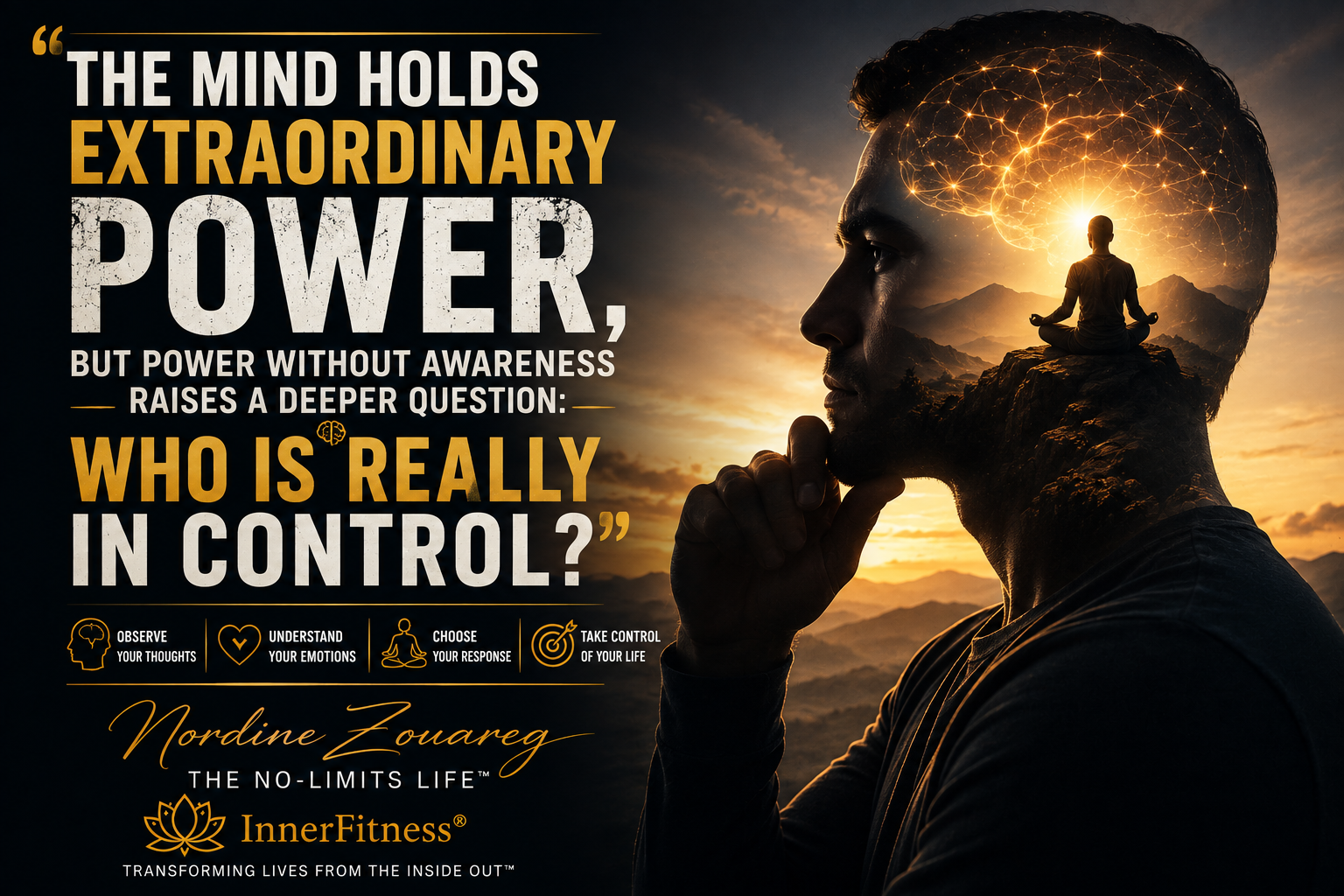
“The mind holds extraordinary power, but the greater power is awareness—the ability to decide who is really in control.”
The Extraordinary Power Within You
The human mind is one of the most extraordinary forces we possess. Everything humanity has ever created began there first. Before the building existed, someone imagined it. Before the invention changed the world, someone believed in a possibility that others could not yet see. Before an athlete broke what appeared to be a physical limitation, the possibility of doing so had to exist somewhere within the mind.
The mind can inspire the body to move beyond perceived limitations. It can transform adversity into determination, fear into preparation, disappointment into wisdom, and possibility into action. It allows us to envision a future different from our present circumstances and then organize our behavior around creating it. Properly directed, the mind can become one of our greatest allies in building a meaningful life.
But power alone is never enough. Any powerful instrument becomes dangerous when the person using it does not understand how it operates. The mind is no exception.
When the Mind Turns Against Us
The same mind capable of creating extraordinary possibilities can also create extraordinary suffering. It can manufacture fear where no immediate danger exists, replay painful experiences that ended years ago, magnify insecurities until they appear to be facts, and create catastrophic scenarios about events that may never happen.
The mind can take one unanswered message and create an entire story around it. It can take one criticism and turn it into a judgment about your worth. It can take one failure and convince you that you are a failure. It can take uncertainty—which is simply not knowing what will happen—and transform it into fear by filling the unknown with the worst possibilities it can imagine.
Nothing outside of you may have changed, yet internally you can experience an entire crisis.
This reveals something important: the mind does not need reality in order to create an emotional response. Sometimes it needs only a thought.
Not Every Thought Deserves Your Attention
One of the most liberating realizations we can have is understanding that thinking something does not automatically make it true. Thoughts appear constantly. Some are useful. Some are insightful. Some are creative. Others are habitual, irrational, fearful, judgmental, or simply remnants of experiences and conditioning accumulated throughout our lives.
Yet many people unconsciously treat every thought as an instruction.
If the mind says, You are going to fail, they hesitate. If it says, They don’t respect you, they become defensive. If it says, You are not good enough, they shrink themselves. If it says, Something terrible is going to happen, their body begins responding as though the imagined danger were already present.
But every thought does not deserve your attention. Every emotion does not require a reaction. Every fear does not deserve obedience. Every impulse does not require action.
Awareness gives you the ability to choose what deserves your energy.
Much of What We Call Thinking Is Repetition
We like to believe that our thoughts are entirely original and consciously chosen. But much of what moves through the mind is repetition.
We repeat beliefs we learned in childhood. We repeat fears created by painful experiences. We repeat judgments absorbed from family, culture, teachers, relationships, successes, and failures. We repeat stories about what kind of person we are, what we deserve, what we cannot do, whom we can trust, and what the future will probably bring.
Eventually, repetition begins feeling like truth.
A child who repeatedly hears that they are not intelligent may eventually stop questioning the belief. Someone who has experienced betrayal may begin assuming everyone is untrustworthy. A person who has failed several times may unconsciously create an identity around failure rather than recognizing those experiences as events from which they can learn.
The mind says, This is who you are.
Awareness asks, Is that actually true?
That question can change a life.
Awareness Creates Space
One of the most important skills we can develop is learning to create distance between ourselves and our thoughts. Without that distance, every thought feels personal and every emotion feels permanent.
Consider the difference between saying, “I am afraid,” and saying, “I am experiencing fear.”
The difference may appear small, but psychologically and spiritually it is enormous. The first statement turns fear into identity. The second recognizes fear as an experience passing through your awareness.
You are not the fear.
You are the one noticing the fear.
The same applies to anger, sadness, insecurity, jealousy, frustration, and self-doubt. These emotions may be real and deserve to be acknowledged, but they do not have to become definitions of who you are.
Awareness creates space between stimulus and response. Within that space exists choice, and within choice exists freedom.
Observe Before You React
Many of life’s unnecessary conflicts occur because we react before we understand what is happening inside us. Someone says something, and we immediately become defensive. Something goes wrong, and frustration takes control. We receive criticism, and Ego rushes forward to protect itself before we have even considered whether the criticism contains something useful.
Awareness interrupts that automatic sequence.
Instead of immediately reacting, you learn to observe. Why did that affect me so strongly? What am I actually feeling? What story am I creating about what just happened? Is my interpretation accurate, or am I filling in information I do not have?
These questions do not make you passive. They make you conscious.
There is enormous strength in being able to experience an emotion without immediately becoming its servant.
Your Emotions Are Messengers, Not Masters
Emotions contain valuable information. Fear may alert you to danger. Anger may reveal that a boundary has been crossed. Sadness may indicate loss. Anxiety may signal uncertainty or unresolved concerns. Joy may show alignment with something meaningful.
We should listen to our emotions.
But listening is different from obeying.
Fear can provide information without making the decision. Anger can be acknowledged without choosing the words that come out of your mouth. Anxiety can be explored without allowing it to dictate your future.
Emotional maturity is not the absence of emotion. It is the ability to experience emotion fully while retaining the capacity to choose your response.
That is awareness in action.
The Mind Is an Extraordinary Servant
The goal is not to silence your mind. Trying to eliminate thought entirely can become another form of struggle. The mind was designed to think, imagine, analyze, anticipate, remember, solve problems, and create possibilities.
The goal is to develop a different relationship with it.
Your mind should be an instrument you learn to use consciously rather than an invisible master directing your life from the shadows. Listen to your thoughts, but question them. Feel your emotions, but examine them. Notice your impulses without assuming you must act upon them.
A powerful mind without awareness can create chaos.
A powerful mind guided by awareness can create extraordinary things.
The difference is not the mind itself.
The difference is who is directing it.
Stop Believing Every Story Your Mind Tells You
Your mind is a remarkable storyteller. Give it a few facts, and it can construct an entire narrative around them. Unfortunately, those narratives are not always accurate.
Someone doesn’t return your call, and the mind decides they are upset with you. A business opportunity becomes uncertain, and the mind predicts financial disaster. You make a mistake, and the mind begins questioning your entire ability. Someone looks at you differently, and the mind creates an explanation without possessing any evidence.
We suffer not only because of what happens, but because of the meaning our minds attach to what happens.
This is why awareness requires curiosity.
Before believing the story, investigate it.
Ask yourself: What do I actually know? What am I assuming? Is there another possible interpretation? Am I responding to reality or to a story my mind created about reality?
These simple questions can prevent enormous unnecessary suffering.
Train the Observer
Just as the body becomes stronger through training, awareness becomes stronger through practice. Meditation is one way to develop it, but awareness is not limited to sitting quietly with your eyes closed. Life itself can become your practice.
Notice what happens inside you during a disagreement. Observe your thoughts when someone criticizes you. Pay attention to the stories your mind creates when you feel ignored, threatened, rejected, or uncertain. Notice how quickly your mind travels into the future or returns to the past.
You do not have to judge what you discover.
Simply observe it.
The more you observe your internal patterns without automatically reacting to them, the easier it becomes to recognize them when they return. Eventually, you begin catching thoughts before thoughts capture you.
That is where transformation begins.
The Freedom of Conscious Choice
Freedom is often described as the ability to do whatever we want. But there is a deeper form of freedom: the ability to choose our response rather than being unconsciously controlled by our conditioning.
If anger determines your behavior, are you truly free? If fear makes your decisions, are you truly free? If other people’s opinions control your self-worth, are you truly free? If old experiences continue determining how you approach new relationships, are you truly free?
External freedom means very little if internally we remain controlled by patterns we never consciously chose.
Awareness allows us to examine those patterns and decide whether they still deserve authority over our lives.
You may not control every thought that enters your mind.
But you can increasingly control which thoughts you entertain, strengthen, question, and ultimately act upon.
Reflective Question
When you look honestly at the decisions, reactions, fears, and assumptions shaping your life today, are you consciously using your mind—or are old thoughts, emotions, and conditioning quietly using you?
Call to Action
For the next week, practice observing before reacting. When a powerful thought or emotion appears, do not immediately suppress it or obey it. Pause and ask yourself, What am I experiencing? What story is my mind telling me? What do I actually know to be true? Give yourself enough space to choose your response consciously. That small pause between thought and action may become one of the most powerful practices you ever develop.
Final Reflection
Your mind possesses extraordinary power. It can imagine futures that do not yet exist, create solutions where others see obstacles, push you beyond perceived limitations, and help transform adversity into purpose. It can become one of the greatest instruments you will ever possess.
But an extraordinary instrument requires an aware operator.
Do not believe every thought simply because you thought it. Do not obey every fear simply because you felt it. Do not allow every emotion to become an identity or every assumption to become a fact.
Observe.
Question.
Understand.
Then choose.
The goal is not to defeat your mind. The goal is to develop such a conscious relationship with it that its extraordinary power begins serving the life you intentionally choose to create.
Your mind can be extraordinarily powerful.
But awareness is greater still.
Because ultimately, the most important question is not how powerful your mind is.
It is who is really in control.
Nordine Zouareg
THE NO-LIMITS LIFE™
InnerFitness® — Transforming Lives from the Inside Out™
Pre-0rder The No-Limits Life Book (Releasing September 15, 2026)
Be a part of the Beta version of the InnerFitness® App