
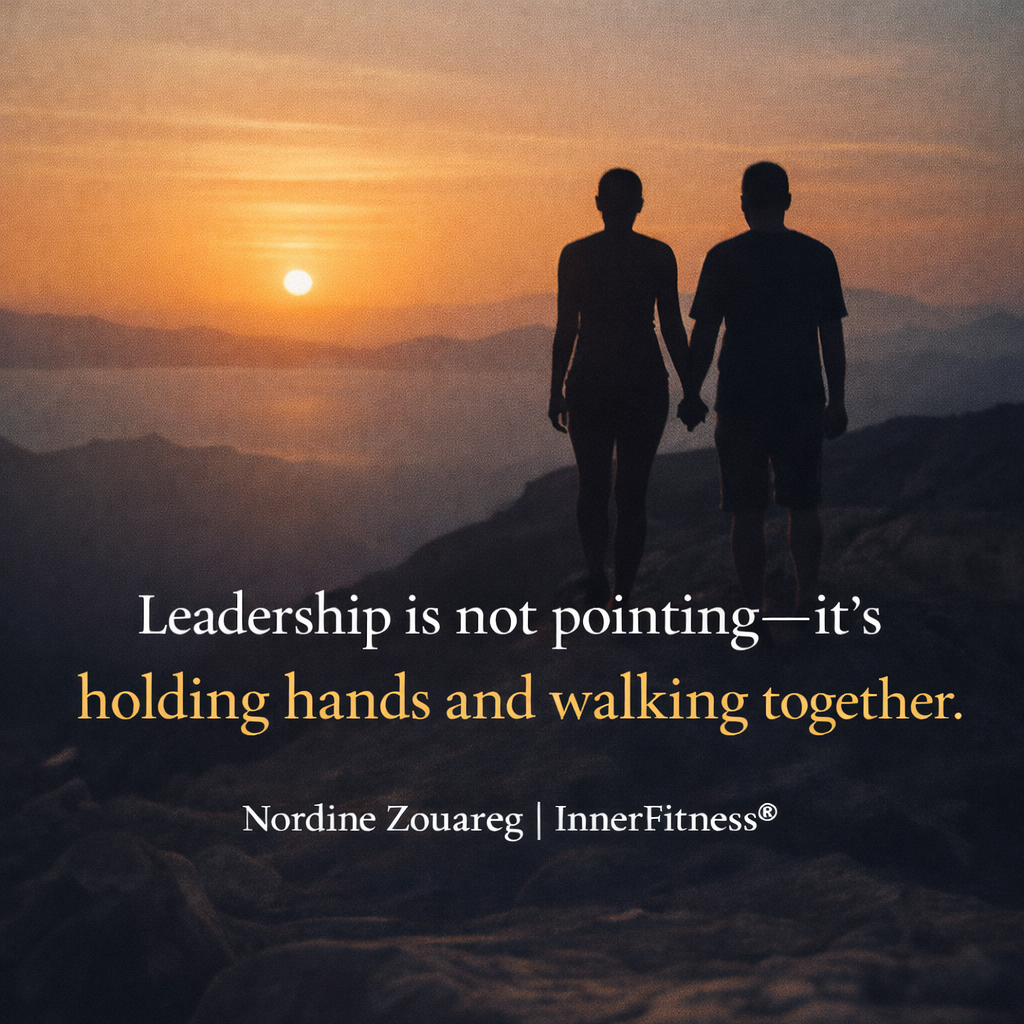
Leadership is not pointing—it’s holding hands and walking together.
Leadership is one of the most misunderstood words in the modern world.
For many, it immediately brings to mind authority, hierarchy, status, and control. The image is familiar: someone standing in front, pointing the way, giving direction, and expecting others to follow.
From a distance, that may look like leadership.
But true leadership is not about distance.
It is about presence.
It is about connection.
It is about walking with people—not simply telling them where to go.
And that difference changes everything.
The Misunderstanding of Leadership
Many people confuse leadership with command.
They think leadership means being the one with all the answers. The one in front. The one who decides. The one who directs.
And while leadership does involve guidance, clarity, and decision-making, those qualities alone are not enough.
Because people do not follow titles for long.
They may obey them.
They may comply with them.
But they do not truly trust them unless something deeper is present.
That deeper thing is connection.
Real Leadership Is Relational
Leadership is not a performance from a distance.
It is relational.
It exists in how you show up with people, not just in what you ask of them.
A true leader does not stand apart from the journey. They enter it.
They understand the effort required.
They understand the uncertainty involved.
They understand what it feels like to move through difficulty, confusion, and growth.
This is what creates credibility.
Not authority alone. Not credentials alone. Not position alone.
But presence.
Why People Follow
People do not truly follow titles.
They follow authenticity.
They follow someone whose words and actions align.
They follow someone who is willing to stand beside them, not above them.
Because when people sense that a leader is disconnected from the reality they are asking others to face, trust erodes.
But when people feel that a leader understands the terrain, has walked through challenge, and is willing to remain involved—
Something shifts.
They feel seen. They feel understood. They feel safe enough to move.
And movement requires safety.
The Power of Walking Together
When I say leadership is holding hands and walking together, I am not speaking about weakness.
I am speaking about unity.
About shared effort. Shared responsibility. Shared humanity.
Holding hands is symbolic of something deeper:
It means you do not leave people alone in the very process you are asking them to endure.
You do not point toward challenge and stay behind.
You move with them.
And this matters—because leadership is not just about vision.
It is about companionship on the path.
Strength Without Distance
Some people believe that proximity weakens leadership.
They think being close to people softens authority or compromises respect.
But the opposite is often true.
Distance may create power. Presence creates trust.
And trust is what sustains leadership over time.
A leader who walks with others does not become less strong.
They become more credible.
Because strength is not found in separation.
It is found in steadiness. In reliability. In the willingness to remain present when things become difficult.
Trust Is Built in Participation
Trust is not built through speeches. It is built through involvement.
Through consistency. Through listening. Through showing up—again and again.
When a leader listens, trust grows.
When a leader adapts, trust deepens.
When a leader remains involved instead of retreating into position, people feel it.
And what people feel determines how they respond.
People will give more to a mission when they believe they are not carrying it alone.
That is the hidden power of real leadership: It turns effort into shared meaning.
Leadership Does Not Remove Itself From Reality
A leader who only points often loses touch with the human side of the journey.
They see goals, timelines, and outcomes—but not always the emotional and practical realities of what people are carrying.
Real leadership stays connected to reality.
It pays attention. It notices. It responds.
It understands that progress is not just about direction—it is about support.
Because even the best direction means little if people feel unseen while walking the path.
People Need More Than Instruction
People do not only need instruction.
They need encouragement. They need understanding. They need stability.
They need to feel that they are part of something meaningful—not just being managed toward an outcome.
This is where leadership becomes transformative.
Not when it simply organizes people.
But when it strengthens them.
A true leader creates an environment where people feel:
- valued
- respected
- motivated
- capable
Not through pressure. Through presence.
Listening Is Leadership
One of the clearest signs of true leadership is listening.
A leader who listens communicates something powerful:
“You matter.” “Your experience matters.” “Your voice matters.”
Listening is not passive. It is active engagement.
It allows a leader to understand what is needed—not just assume it.
It builds alignment because it invites participation rather than forcing compliance.
And alignment is far more powerful than control.
Control may move people for a while.
Alignment moves them with heart.
Adaptation Is Strength
Walking with people means you are willing to adapt.
You do not hold so tightly to your own perspective that you miss what is happening around you.
You observe. You adjust. You stay flexible without losing direction.
This is not weakness. This is leadership maturity.
Because leading real people in real situations requires responsiveness.
Not rigidity.
Respect Cannot Be Demanded
This kind of leadership does not demand respect.
It earns it.
Quietly. Consistently. Over time.
Through:
- presence
- honesty
- steadiness
- involvement
- care
People can feel the difference between someone who wants authority and someone who accepts responsibility.
One wants position. The other accepts burden.
And true leadership always carries burden.
Leadership and Inner Strength
Leadership begins internally.
Before you can walk with others, you must learn how to stand within yourself.
You need:
- clarity
- emotional stability
- self-awareness
- the ability to regulate your own fear, pride, and impatience
This is why inner work matters so much in leadership.
Because if you are disconnected from yourself, you will eventually disconnect from others.
But when you are grounded internally, you create steadiness externally.
This is InnerFitness® in action.
Leadership is not only what you do.
It is what you embody.
The Shared Nature of Progress
Progress is not an individual act.
It is shared.
Even when one person holds responsibility, growth happens in relationship.
A leader who understands this does not isolate themselves from the process.
They join it.
They become a stabilizing presence inside the movement.
They remind people that they are not walking alone.
And that sense of togetherness changes everything.
Because people are capable of more when they feel supported.
Strength multiplies when it is connected.
A Question for Every Leader
If you see yourself as a leader, ask yourself honestly:
Are you pointing—or are you walking?
Are you directing from a distance—or participating in the path?
Are you asking people to trust you—or earning that trust through presence?
Because leadership is not about showing the way from far away.
It is about being there.
Step by step.
Together.
The Kind of Leadership the World Needs
The world does not need more leaders who stand above people.
It needs more leaders who stand with them.
Leaders who:
- guide without disconnecting
- strengthen without controlling
- support without performing
- influence through authenticity rather than position
This kind of leadership changes lives.
Because people remember how you made them feel while they were growing.
They remember whether you were present.
They remember whether you walked with them.
Call to Action
Today, in whatever role you hold—at work, in your family, in your community—ask yourself one simple question:
How can I walk with someone instead of just directing them?
Listen more deeply. Stay more present. Support more intentionally.
Because leadership is not proven by how far ahead you stand.
It is revealed by how willing you are to stay connected while others move forward.
Final Reflection
Leadership is not pointing—it’s holding hands and walking together.
Not because leadership lacks strength—
but because true strength does not need distance to be respected.
It needs presence. It needs connection. It needs authenticity.
So if you lead, lead closely.
Walk with people. Listen to them. Support them. Guide them without leaving them behind.
Because in the end, the leaders people remember most are not the ones who stood above them.
They are the ones who walked beside them.
Disclaimer
This article is meant to inspire reflection and promote wellbeing. It is not a substitute for professional medical or mental health advice. If you or someone you know is struggling with insomnia, stress, or emotional distress, please seek help from a qualified healthcare or mental health professional. Remember: asking for help is an act of courage and self-care.
— Nordine Zouareg | InnerFitness® — Transforming Lives from the Inside Out™
Pre-0rder The No-Limits Life Book