
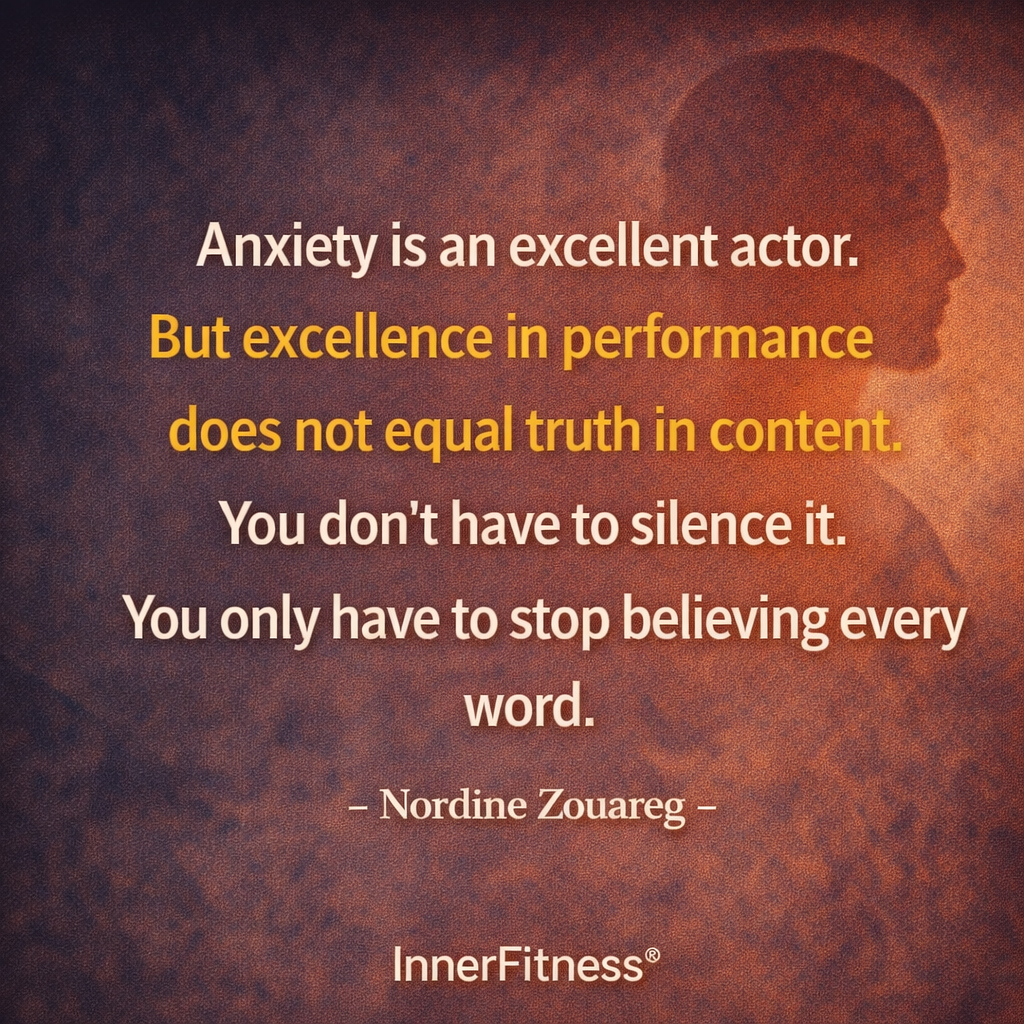
“Anxiety is an excellent actor. But excellence in performance does not equal truth in content. You don’t have to silence it — you only have to stop believing every word.”
Anxiety is an excellent actor.
It performs catastrophe so convincingly that you believe the disaster is real. It turns possible futures into certain doom. It inflates small concerns into existential threats. And it does all of this using nothing but imagination and adrenaline.
That’s the part most people miss.
Anxiety does not report facts.
It performs stories.
And it performs them brilliantly.
The Oscar-Worthy Performance
Anxiety deserves an award for its dedication to the role.
It takes a presentation and turns it into career-ending humiliation.
It transforms a text left on read into relationship destruction.
It converts a minor mistake into proof of your fundamental inadequacy.
And it does this with visceral detail.
The racing heart feels real.
The tight chest feels real.
The worst-case scenarios feel inevitable.
The sense of impending doom feels factual.
Your body reacts as if the threat is present now. Your nervous system mobilizes. Your mind sharpens around imagined danger. And suddenly, you are living inside a future that has not happened.
Anxiety does not whisper; it performs.
It stages elaborate productions of disaster that haven’t occurred, danger that doesn’t exist, and futures that will never arrive.
The Physiology of the Performance
Anxiety is not random. It is a survival system doing what it was designed to do: scan for threats.
In its original context, this was useful.
A rustle in the bushes could be a predator.
A shift in the environment could signal danger.
Preparation improved survival.
But modern life rarely presents predators in bushes. It presents emails, deadlines, conversations, social interactions, performance demands, and uncertainty.
Your nervous system does not distinguish well between physical threat and social discomfort. It mobilizes the same chemistry.
Adrenaline rises.
Heart rate increases.
Breathing shifts.
Attention narrows.
The body prepares for impact—even if the impact exists only in imagination.
This is what makes anxiety convincing.
It doesn’t just tell a story. It creates physical evidence to support it.
The sensation becomes proof.
And sensation is persuasive.
The Fiction That Feels Like Fact
Here’s what anxiety never tells you while it’s performing:
It is crafting fiction.
Anxiety specializes in preview trailers for movies that never get made. It produces catastrophic storylines that feel so real you experience them as if they are unfolding right now.
It says:
- “You’re going to embarrass yourself.”
- “They’re going to leave.”
- “You’re not prepared enough.”
- “Something is wrong.”
And because your body is activated, you assume the script must be true.
But anxiety is not predicting the future.
It is imagining it.
Imagination is powerful—but it is not prophecy.
The Cost of Believing the Script
When you mistake anxiety’s performance for reality, you pay real consequences.
You lose sleep over conversations that go fine.
You avoid opportunities that would have gone well.
You distance yourself from people who were not leaving.
You delay decisions because you’re bracing for failure.
The tragedy is not the anxiety itself.
The tragedy is suffering through disasters that exist only in imagination.
Real emotional energy is spent on fictional crises.
That exhaustion compounds over time.
Anxiety’s Job vs. Your Job
Anxiety has a job.
Its job is to imagine threats.
It does not check for accuracy.
It does not balance perspective.
It does not verify probability.
It scans and exaggerates.
Your job is different.
Your job is discernment.
You are not required to eliminate anxiety.
You are required to interpret it accurately.
Anxiety’s presence does not mean danger is real.
It means your nervous system has activated.
That distinction changes everything.
Recognizing the Performance
Power begins when you recognize the performance for what it is.
When anxiety begins its monologue about everything that could go wrong, you do not have to silence it. You do not have to fight it. And you do not have to obey it.
You can observe it.
You can say:
“Ah. Anxiety is performing again.”
This creates separation.
You are no longer inside the script.
You are watching it.
And when you are watching it, you regain choice.
Buying a Ticket to the Show
Most people do not just watch anxiety’s performance.
They buy a ticket.
They sit in the front row.
They let it run for hours.
They argue with it.
They rehearse counter-scripts.
They try to outthink it.
But arguing with anxiety often strengthens the performance. It gives it stage time.
Instead of debating every line, try acknowledging the actor without engaging the script.
“Yes, anxiety is doing its thing.”
“But that does not make this true.”
You do not have to attend every performance.
Separating Sensation from Story
The body sensations are real.
The racing heart is real.
The sweating is real.
The tension is real.
The story attached to those sensations is often not.
This is one of the most important distinctions you can make.
The sensation says:
“Your nervous system is activated.”
The story says:
“Something terrible is about to happen.”
The body is telling you about activation.
The mind is telling you a narrative.
Learn to separate the two.
Respond to the activation—through breathing, grounding, movement.
Question the narrative.
The Practice of Perspective
Ask yourself:
- What evidence supports this thought?
- What evidence contradicts it?
- Has this disaster actually happened before?
- Am I predicting or observing?
Anxiety speaks in certainty:
“This will go badly.”
Reality speaks in probability:
“It might. It might not.”
Return to probability.
Anxiety as an Overprotective Alarm
Anxiety is not your enemy.
It is an overprotective alarm system.
The problem is not that it exists. The problem is that it is hypersensitive.
You don’t remove the alarm system.
You recalibrate it.
That recalibration happens through repeated experiences of:
- acting despite fear
- seeing outcomes that contradict catastrophe
- teaching your nervous system that discomfort is not danger
Each time you move forward and nothing terrible happens, you gather evidence.
Evidence weakens the performance.
The Discipline of Non-Participation
When anxiety begins rehearsing future disasters, you can practice non-participation.
You do not suppress it.
You do not amplify it.
You simply decline to join the story.
You return to what is happening now.
What is real in this moment?
Often, the answer is simple:
You are sitting.
You are breathing.
Nothing catastrophic is occurring.
Presence disrupts projection.
Courage Redefined
Courage is not the absence of anxiety.
Courage is acting while recognizing the performance.
It is saying:
“I see what you’re doing.”
“And I’m moving anyway.”
Each time you act from clarity instead of fear, you weaken anxiety’s authority.
The Curtain Falls
Anxiety is an excellent actor.
But actors rely on audience participation.
The curtain falls when you stop mistaking the performance for reality.
It falls when you:
- recognize sensation without surrendering to story
- observe the monologue without buying the ticket
- move forward without waiting for silence
Anxiety may continue performing from time to time.
But its script no longer runs your life.
Call to Action
The next time anxiety begins its production, pause.
Name it:
“This is anxiety performing.”
Breathe.
Ground yourself.
Return to observable facts.
Then take one small action aligned with reality—not fear.
Do this repeatedly.
Over time, the performance loses credibility.
Reflective Question
Where in your life have you been reacting to anxiety’s script instead of responding to reality—and what would change if you recognized the performance for what it is?
Anxiety is an excellent actor.
But excellence in performance does not equal truth in content.
You do not have to silence it.
You only have to stop believing every word.
That is where freedom begins.
Disclaimer
This article is meant to inspire reflection and promote wellbeing. It is not a substitute for professional medical or mental health advice. If you or someone you know is struggling with insomnia, stress, or emotional distress, please seek help from a qualified healthcare or mental health professional. Remember: asking for help is an act of courage and self-care.
— Nordine Zouareg | InnerFitness® — Transforming Lives from the Inside Out™
No-Limits Life Podcast (Listen or Watch)